
The Fundamental Architectural Divergence
Choosing between a slant bed turning center (such as the SDS TCK50 / TCK52 / TCK56) and a traditional flat bed CNC lathe (such as the SDS CK6140 / CK6150 / CK6160) is one of the most critical decisions in production line planning.
While both machines execute CNC turning, threading, grooving, and facing, their mechanical architecture directs cutting reaction forces and thermal energy in fundamentally opposite manners.
Mechanical Rigidity and Force Vector Dissipation
In a Flat Bed Lathe (CK Series), the cutting tool exerts force upward and outward relative to the horizontal slideways. This geometry creates a lever moment arm between the cutting tip and the bed ways:
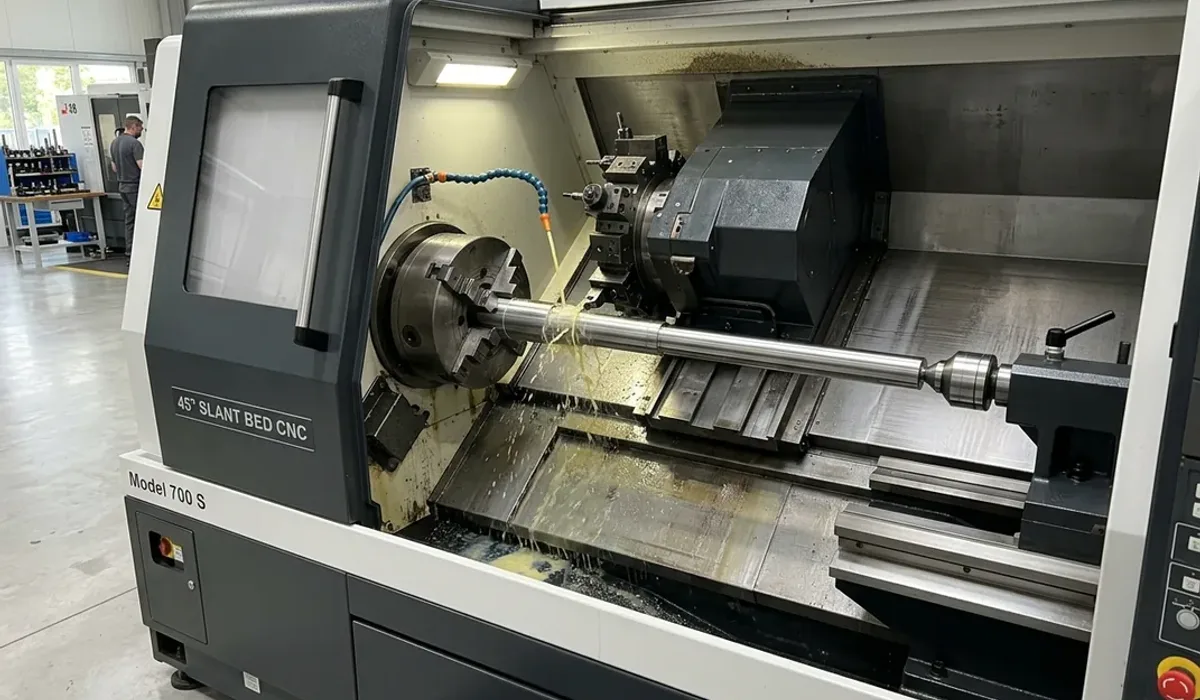
In a Slant Bed Lathe (TCK Series), the bed casting is cast at a 30° or 45° angle:
The Unseen Bottleneck: Continuous Chip Evacuation
In mass manufacturing, machine downtime is frequently caused by manual chip clearing rather than mechanical failure: 1. Flat Bed Challenges: Metal chips fall directly onto the bed ways and carriage saddle. Long stringy chips from ductile steels accumulate around the chuck and lead screws, requiring operators to pause cutting cycles to clear debris manually. 2. Slant Bed Advantage: The 45° incline creates a sheer vertical drop under gravity. Red-hot chips and coolant drop cleanly between the bed ways directly into the integrated steel hinge belt conveyor. This allows true unattended lights-out production.
Tooling Systems: Electric Toolpost vs Hydraulic Servo Turret
Total Cost of Ownership (TCO) & Payback Calculation
| Operational Factor | CK Flat Bed Series | TCK Slant Bed Series |
|---|---|---|
| Initial Capital Investment | Lower ($12,000 - $24,000) | Moderate ($28,000 - $48,000) |
| Indexing Speed | 2.5 - 3.5 seconds | 0.25 seconds |
| Chip Evacuation | Manual / Drag Conveyor | Gravity Auto-Drop Conveyor |
| Best Suited Lot Sizes | 1 - 100 pcs (Job Shop) | 100 - 100,000+ pcs (Production Line) |
| Typical Operator Ratio | 1 Operator per 1 Machine | 1 Operator per 3-4 Machines |